
A Collective Approach to Doing Therapy Differently
The Rhode Island ACT Collective (RIACT) is more than an organization, it’s a living ecosystem of clinicians, educators, and community partners working together to build a flexible, values-driven model for mental health practice.
Where traditional agencies rely on hierarchy and compliance, RIACT functions as a collective, a community built on shared purpose, transparency, and collaboration. Each member remains independent while connecting to shared systems that make sustainable practice possible.
Function Over Form
Our structure is guided by Functional Contextualism, Relational Frame Theory, and Acceptance and Commitment Therapy (ACT).
This means decisions are based on what works, clinically, ethically, and contextually, rather than rigid policy or profit.
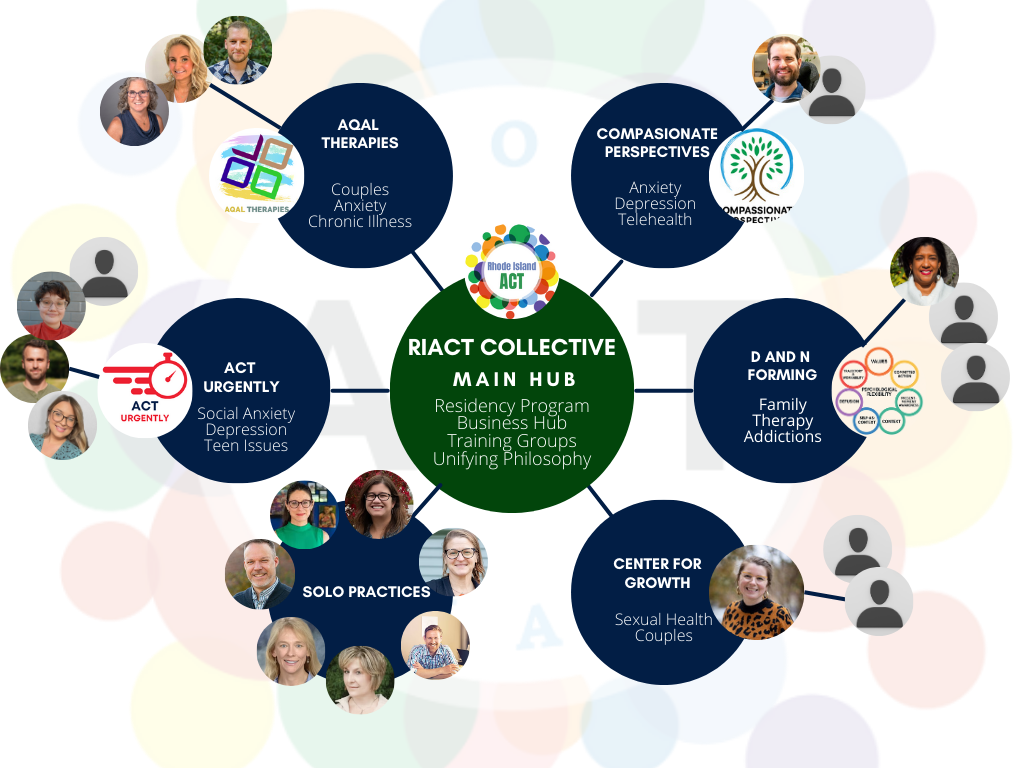
The Hub-and-Pod System
RIACT uses a hub-and-pod model:
- Hubs provide shared infrastructure: billing, supervision, training, and community outreach.
- Pods are small, semi-autonomous teams that adapt those systems to their own clients and communities.
- All of these hubs are projected to connect back to The Association for Contextual Behavioral Science and The Institute for Better Health.
This design balances flexibility and cohesion, allowing innovation to grow from the ground up while staying connected through common values and tools.
Shared Strengths
- Collaborative Infrastructure: Members share resources for marketing, billing, and technology.
- Peer Supervision: Built-in feedback and learning loops modeled on the Evoke–Model–Reinforce framework.
- Sustainable Practice: Lower overhead and pooled support systems mean more time for clinical work.
- Professional Autonomy: Structure without rigidity, each clinician directs their own practice within a supportive network.
- Systemic Resilience: A decentralized model that adapts to change while keeping care front and center.
Why It Matters
RIACT was created to protect the soul of the profession—to ensure that clinicians remain connected, grounded, and guided by the same compassion and curiosity that brought them into this field.
Together, we’re not just building practices; we’re re-building the system—one hub, one pod, one connection at a time.


Leave a comment