

The Six Processes
ACT aims to help individuals cultivate psychological flexibility, which involves focusing on six underlying processes:
Acceptance: (sometimes called expansion) Recognizing and making room for unpleasant thoughts and emotions without trying to suppress or avoid them. This process is about creating space for emotions, impulses, and feelings that we might otherwise suppress or avoid. Developing skills within this process allows us to avoid over-inflating them or wasting too much energy on them so that we can move on more easily.
Purpose: Support whatever inner experience are present when doing so fosters effective action.
Method: Reinforce approach responses to previously aversive inner experiences, reducing motivation to behave avoidantly (altering negatively reinforced avoidance patterns.)
When to use: When escape and avoidance of private events prevents positive action.
Defusion: Viewing thoughts as transient mental events rather than objective truths, and learning to detach from unhelpful thoughts. Typically done via mindfulness practices, these activities involve recognizing psychological experiences objectively rather than perceiving them as perceived threats or realities. Thoughts are thoughts and not necessarily true, clever, or important. Our feelings, therefore, are simply feelings and not omens of impending doom.
Purpose: to see thoughts as what they are, not as what they say they are.
Method: Expand attention to thinking and experiencing as an ongoing behavioral process, not a causal, ontological result.
When to use: When private events are functioning as barriers due to FEAR (fusion, evaluation, avoidance, reasons).
Being Present: Paying attention to the present moment and fully engaging in what is happening right now. These processes foster greater awareness of how we’re currently feeling, both physically and mentally. Exercises are aimed at engaging completely with the present moment versus dwelling on the past or worrying about the future.
Purpose: To notice what is currently happening in the moment versus orientation on the past or the future. To notice the unworkability of the system by naming that system as inappropriately or excessively applied control strategies which have been generally applied across all contexts to allow examination of why this does not work.
Method: Slowing the moment down by focusing in on what the five senses observe such as the breath, thoughts, memories and other sensations.
When to use: As a precursor to the rest of the work in order for new responses to emerge, especially when the client is significantly struggling including revisiting or providing evidence for why it should work multiple times (points to rule).
Self-as-Context: Recognizing that one’s thoughts and emotions are not the core of one’s identity, but rather experiences that come and go. This process helps to develop the ability to be able to view our psychological and physical experiences as transient and ever-changing and allow us to let go or step away from these perceived emotions, sensations, and thoughts that define us.
Purpose: Make contact with a sense of self that is a safe and consistent perspective from which to observe and accept all changing inner experiences.
Method: Mindfulness and noticing the continuity of consciousness.
When to use: When the person needs a solid foundation in order to be able to experience personal events and/or when overidentifying with the conceptualized self (personal rule)
Values: Clarifying and connecting with what truly matters to you in life, and using these values as a guide for making decisions and taking action. The process creates a space where one can explore and clarify the things that are personally meaningful. This process is used to help clients find direction and motivation.
Purpose: To clarify what the client values for its own sake. What gives the client’s life meaning?
Method: To distinguish choices from reasoned actions and to understand the distinction between a value and a goal.
When to use: Whenever motivation is at issue. After defusion and acceptance have removed avoidance as a compass.
Committed Action: Taking effective and meaningful steps towards one’s values, even in the presence of difficult thoughts and emotions. This process is about identifying and setting up long-term life goals that are values-based. This helps to get a client “unstuck” as they commit to and work with engagement toward goals through action.
Purpose: To set the client in action and build confidence, motivation, ad curiosity in discovering possible new outcomes.
General method: Help clients identify and declare behavioral tasks that align with chosen values.
When to use: Whenever values have been solidified and described with clarity and defusion and acceptance have removed or lessened avoidance.
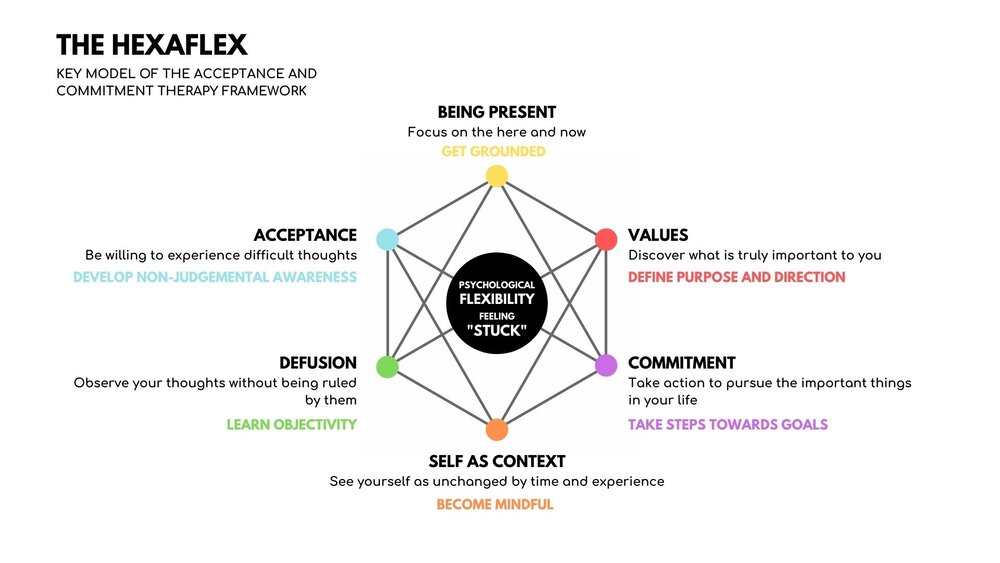
With these six processes, the therapist works collaboratively with the client to explore their experiences, identify patterns of avoidance or control, and support the adoption of more flexible and value-driven behaviors. This includes utilizing various therapeutic techniques and exercises to help individuals develop these skills, including mindfulness practices, metaphors, experiential exercises, and behavioral experiments.
ACT has been used to treat a wide range of mental health conditions, including anxiety disorders, depression, substance abuse, chronic pain, and relationship difficulties. It is also applicable in non-clinical contexts, such as improving performance in sports or enhancing overall well-being.



Leave a comment